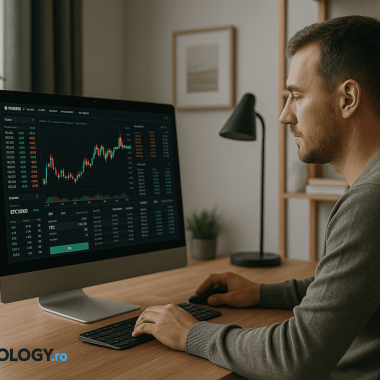

Picture a spreadsheet holding a year of crypto trades, with plenty of winners in it and almost nothing that repeats. Each row has its own coin and its own size, and the reason scribbled next to it changes from week to week. A sheet like that can look fine for months and still never explain where the money went.
Yes, with a condition attached. Xcelerate Trade gives you the parts a repeatable crypto trading process is built from, namely a structured Academy, playbooks with written entry and stop rules, replay and demo practice, and a performance journal for review. It can’t follow those rules on your behalf, and that’s the part that decides whether anything actually repeats.
Xcelerate Trade is an online trading education platform that pairs a ten-chapter Academy with replay sessions, demo trading, rule-based strategy playbooks and a marketplace of trader portfolios, with lessons published in English, Romanian, Spanish and French. I went through its public pages with one question in mind, whether it can make crypto trading boringly consistent.
What a repeatable crypto trading process actually is
A repeatable crypto trading process is a written set of decisions you make the same way every time, covering the market, the hours, what counts as a setup, where the idea is proven wrong, how big the position is and how you review it afterwards. The simplest test I know is whether a stranger could read your rules and take the same trade on the same chart, and if they could, you have a process.
If they’d have to ask what you meant by “strong momentum” or “looks heavy”, you have a habit, and habits drift. A “small” position can creep from one percent of the account to three or four over a few months without anyone deciding it on purpose.
Repeatable doesn’t mean profitable
A process can be perfectly consistent and still lose money, the same way a recipe can be followed to the gram and still taste bad. What repeatability gives you is a result you can measure, so you can tell whether you have an edge, a statistical advantage that shows up over many trades, instead of guessing.
Without it, every losing week has a hundred possible explanations. With it, there are usually two or three, and the journal tells you which one it was.
Why crypto makes consistency harder
Crypto adds problems that stock and futures traders don’t face in quite the same form. The market never closes, so there’s no opening bell to anchor a routine and no closing bell to send you to bed. Liquidity, the volume of buy and sell orders sitting near the current price, often thins out at weekends, and the spread, the gap between the best buying and selling price, can differ noticeably from one exchange to another.
Leverage, which lets you hold a position larger than your deposit, is where the differences get widest. When ESMA restricted contracts for difference, derivatives that track an asset’s price without you owning it, for retail clients in 2018, it capped leverage on crypto CFDs at 2:1, the lowest limit in the whole package. Some crypto exchanges outside that framework have offered more than 100 times on perpetual futures, contracts with no expiry date, so two people running the “same” strategy can carry completely different risk simply because of where they pressed buy.
Why do most traders never build one?
Most traders never build a repeatable process because they assume screen time turns into skill on its own, and the best data we have on retail traders says it usually doesn’t. I’d rather you saw the numbers now than after your first blown account.
The study I come back to most often is by Fernando Chague, Rodrigo De-Losso and Bruno Giovannetti. They followed every individual who started day trading mini-Ibovespa futures in Brazil between 2013 and 2015, close to twenty thousand people, and found that 97% of those who kept going for more than 300 days lost money. The line that stuck with me is a quieter one, though. The authors found no evidence that people got better by day trading.
Taiwan tells a similar story over a much longer stretch. Brad Barber, Yi-Tsung Lee, Yu-Jane Liu and Terrance Odean studied day traders in Taiwan from 1992 to 2006 and found that fewer than 1% could predictably earn positive abnormal returns after fees, meaning returns above what the market itself delivered. In Europe, the national regulators whose analyses ESMA relied on found that between 74% and 89% of retail CFD accounts typically lost money.
None of these studies looked at crypto specifically, and I’d be careful with anyone who claims otherwise. I just can’t think of anything about a high-leverage market that trades around the clock that would make it kinder.
Repetition without feedback repeats the mistake
The Brazilian result is the best argument I know against “just keep trading” as advice. Hundreds of sessions should have taught those traders something. The study doesn’t say why they didn’t improve, and my guess is that nothing forced them to compare what they did with what they had planned to do.
That’s the gap a process closes. Once the rules are written down and every trade is checked against them, a losing month stops being noise and turns into information.
What pilots and surgeons figured out first
Pilots and surgeons adopted written checklists long before traders started talking about process, and medicine has published numbers showing how much difference one can make.
In October 1935, Boeing’s Model 299, the prototype of what became the B-17, crashed on takeoff at Wright Field in Ohio. The crew was very experienced, and the Army board that investigated blamed a locked elevator control that nobody had freed in time. Air Corps personnel concluded that the real limit was human memory rather than the aircraft’s complexity, so they wrote checklists for each phase of flight, and those became standard practice.
In 2009 the New England Journal of Medicine published a study led by Alex Haynes on a 19-item surgical safety checklist based on World Health Organization guidelines, tested in eight hospitals on several continents. Deaths during hospitalization fell from 1.5% to 0.8% once the checklist was in place, and complications dropped from 11% to 7%.
Nobody in those operating rooms suddenly became a better surgeon. What changed was adherence to basic steps, with the appropriate use of preventive antibiotics, for example, rising from 56% to 83%.
The Turtle experiment
Trading got its own experiment in 1983, when the commodities trader Richard Dennis made a bet with his partner William Eckhardt about whether trading could be taught, then recruited a group of novices, later known as the Turtles, through newspaper ads. He handed them a fully written trend-following system, meaning one that joins a move in either direction and stays in while it lasts.
Beyond entries and exits, the rules set position size according to each market’s volatility, how far its price typically moves in a given period. Not every Turtle did well. What the experiment showed is that rules can be passed from one person to another and executed by people with very different temperaments, and that’s about as good a definition of a repeatable process as I’ve found.
How Xcelerate Trade splits the process into parts you can practice
Xcelerate Trade organizes the platform into four connected layers, learning paths, practice environments, strategy access and a marketplace, and each one lines up with a stage of a repeatable process. The homepage pitches it, a little unglamorously, at active chart users who want a written process they can follow day after day, which is exactly the person asking this question.
The Academy as a fixed sequence
The core course, Xcelerate Trade Academy, runs across 10 chapters and roughly 70 lessons, about 27 and a half hours of material. It moves from basic concepts, capital and risk management through analysis and psychology to applying the Xcelerate strategy in practice, and the course description itself is aimed at traders who want a clear, repeatable process.
In my view the order of the lessons matters more than any single one of them. Self-taught learning tends to start with indicators, the formulas that turn price or volume into a line on the chart, and reaches risk last, which is a bit like learning to steer before you’ve found the brakes. A fixed sequence stops you from skipping the dull chapters that end up mattering most.
Playbooks that turn a setup into rules
The playbooks are the part of Xcelerate.Trade I’d point a beginner to first, because they show what a written rule actually looks like. The free ORB strategy is a good example, ORB standing for opening range breakout, where the opening range is the high and low set during the first stretch of a session. You lock that range, wait for a breakout on volume and enter only when price comes back to the broken level and gets rejected there.
The stop loss, the pre-set exit that caps the loss, and the risk-to-reward ratio, the possible gain measured against the amount at risk, are fixed before you click anything. Crypto needs one extra adjustment, because Bitcoin has no opening bell. The companion Best ORB Detector Dynamic indicator builds the range around the Asia, London or New York session instead, which in effect borrows a clock from traditional markets and gives a 24/7 routine a fixed starting point.
Replay and demo as rehearsal
Replay mode, as Xcelerate Trade describes it, lets you rerun historical sessions and refine entries and exits without market pressure. Demo trading then moves the same rules onto live prices with virtual capital. The homepage sums up the approach in six words: “Small reps beat long binge nights.”
In practice that means two or three short replay sessions on weekday evenings rather than one marathon on Sunday. Attention fades over a long session, and a rule checked half asleep on the fortieth trade isn’t really being tested.
The performance journal as the feedback loop
The performance journal is where the review happens, and I think it’s the most underrated tool on the platform. Xcelerate.Trade describes its purpose as reviewing trades to catch recurring mistakes and track progress over time. That’s the step I suspect was missing for the Brazilian traders, a regular comparison between what you planned and what you actually did.
How I’d build the process on the platform, step by step
Building a repeatable crypto process on Xcelerate Trade comes down to narrowing your choices, writing rules precise enough to check, sizing every trade from the stop and reviewing results in R, the amount risked on each trade, rather than in dollars. What follows is the order I’d use if I were starting from scratch.
One coin, one window
Start with one coin and one time window. Bitcoin or Ether is usually the sensible pick, since liquidity is deepest and spreads are tightest there. A single session, say the London morning or the New York open, gives you the same conditions to practice in every day.
I’d also leave weekends alone for the first couple of months. Weekend order books, the lists of buy and sell orders waiting at each price, are often thinner and can make a setup behave differently. You want your early data to come from one environment rather than two you can’t separate later.
Write the setup so a stranger could trade it
Every rule needs a condition you can check without interpretation. “Price breaks the session high on volume at least 1.5 times the 20-bar average” is a rule, while “price looks strong” is closer to a mood. Write down the context you need, the trigger and any confirmation, and before all of that, the point at which the idea is wrong.
Then add the conditions under which you won’t trade at all, such as a major macro release within the hour or a spread running at twice its normal width. I’d argue these skip conditions protect an account better than any entry rule, and they tend to be the last rules a beginner thinks of writing.
Size every position from the stop
Position size should come out of a calculation, never a feeling. Say you have a $5,000 account and risk 1% per trade, which is $50. Suppose Bitcoin is at $60,000 and your stop sits $600 below the entry, so the position is 50 divided by 600, about 0.083 BTC, or roughly $5,000 of exposure with no leverage involved.
Costs belong in the same calculation. A taker fee is what you pay when your order fills immediately against orders already waiting, and at 0.1%, a standard rate on several large spot exchanges where you buy the coin itself, getting in and out of that position costs about $10. That’s a fifth of your risk on every single trade, which you won’t notice once but which over a hundred trades can decide whether the strategy ends up positive.
It helps to know the drawdown math before you need it, too. A drawdown is the fall from an account’s peak, and a 20% one needs a 25% gain to get back to even, while a 50% drawdown needs a 100% gain. That arithmetic is why the 1% rule feels slow right up until the week it saves you.
From practice to a small live account
I’d run the written rules in replay until I had at least fifty trades logged, then move to demo, sized as if the demo balance were the money I actually plan to deposit. A $100,000 demo account teaches very little if you’re going live with $3,000. Only after that would I put real money in, and even then at a quarter of my normal risk for the first month.
Review in R, weekly and monthly
A trade that made $100 on $50 of risk is +2R, and a full stop-out is -1R. Measuring in R puts every trade on the same scale, whatever the stop distance or the account size.
Expectancy, the average result per trade across many trades, is the number that matters most. With a win rate (the share of trades that end in profit) of 40%, an average win of 2R and losses capped at 1R, each trade is worth 0.4 times 2 minus 0.6 times 1, which comes to 0.2R on average. That’s a positive edge even though you lose more often than you win, and it shows why the win rate says so little on its own.
Each week, I’d check only one thing, whether the plan was followed, using a plan-adherence column with a plain yes or no. Each month, the review moves to expectancy and average loss size, broken down by the hour the trades were taken. I wouldn’t judge the strategy itself until there are about a hundred trades in the sample, since twenty trades can make a bad system look brilliant and a good one look broken.
Where does scalping fit, and why does it test the process hardest?
Scalping, trading for very small price moves and holding positions for seconds or minutes, is the toughest test for a repeatable process because it multiplies the decisions you make per hour, so every loose rule gets exposed faster. I’d keep it for the end of the learning sequence rather than the beginning.
Fees are the first reason. Keep the same $5,000 account and $50 of risk, but tighten the stop to 0.25%, which is $150 on a $60,000 Bitcoin. The position grows to a third of a coin, around $20,000 of exposure, and the round-trip taker fees now come to roughly $40, or 0.8R gone before the market has moved at all.
That position also needs leverage of about four times. If you trade crypto CFDs with an EU-regulated broker, the 2:1 cap means you couldn’t open it on that account at all.
If short timeframes still pull at you, I’d head for the Crypto Scalping Strategies material in the Academy on Xcelerate.Trade, which centers on execution on low timeframes and on reading order flow, the stream of buy and sell orders hitting the market. Treat it as a stress test for rules you’ve already proven on slower charts. The platform’s Order Flow PRO indicator, which tracks delta, the difference between buying and selling volume, on TradingView, earns its place here too, though only once you know which question you’re asking the order flow.
What the platform won’t do for you
Xcelerate Trade won’t make a process profitable, and it can’t stop you from breaking your own rules at two in the morning after a loss. Its homepage states plainly that nothing on the site promises profit and that tools support a plan without replacing one.
Membership tiers, Silver, Platinum and Diamond, open premium playbooks and tools, and the platform describes that step as optional for anyone who’s just starting to learn. Pay for more access once the free material has become a routine you actually keep, because no subscription can sell you discipline you don’t have yet.
The same goes for automation and the marketplace. A bot executes rules perfectly, including the bad ones, and copying another trader’s portfolio gives you their results without their reasoning. Both become useful once you understand why the rules exist, while before that point they mostly hide the learning you came for.
Signs the process is starting to repeat
The earliest sign shows up in the numbers, with your average loss staying close to 1R instead of occasionally ballooning to 3R and the plan-adherence column saying yes on at least nine trades out of ten.
Boredom is another sign, and in my opinion the most reliable one. Once the routine is predictable, trades stop feeling like events, and decisions start following the data rather than the mood of the session.
Questions readers ask about repeatable crypto trading with Xcelerate Trade
Does Xcelerate Trade require identity verification to start learning?
No identity check is needed for the learning side of the platform. Xcelerate Trade states that it doesn’t run identity KYC (know your customer) checks for learning and relies only on technical protection against abuse. Any exchange or broker you later trade with will apply its own verification rules.
Can I use the same process for Bitcoin and altcoins?
Usually not without adjustments. Smaller altcoins tend to have thinner order books and sharper swings, so a stop distance that works on Bitcoin can be far too tight on a low-cap token. Test each new asset in replay as though it were a new strategy, and give its trades a separate tag in the journal.
How long before the routine feels automatic?
There’s no reliable number, and I’d be wary of anyone who gives you one. I’d expect a routine built on short daily practice sessions to start feeling natural within a few weeks. Knowing whether the strategy has a real edge takes longer, often a few months, because you need a sample of around a hundred logged trades.
Does the same process work on spot and on perpetual futures?
Mostly, though perpetual futures add costs and risks that spot trading doesn’t have. Perpetual futures are derivative contracts with no expiry date, kept close to the spot price by a funding rate, a periodic payment between buyers and sellers. They can also close your position automatically, which is called liquidation, when the margin, the collateral behind the position, runs too low. I’d build the rules on spot first and log perpetual trades as a separate condition in the journal.
Can copy trading replace building my own process?
Copy trading, automatically mirroring another trader’s positions, can give you exposure to someone else’s process, but it won’t teach you one. If you use the Xcelerate Trade marketplace, treat a copied portfolio as a case study, log its trades as if you had taken them yourself, and ask whether you would have stuck to the same rules through the losing weeks.
Is a trading bot automatically a repeatable process?
A trading bot, software that places orders according to coded rules, is perfectly repeatable in execution, which is exactly why its rules need validating first. Automation on Xcelerate Trade, including the MetaTrader tools that are still in preview, makes sense after a manual process has shown positive expectancy, a positive average result per trade, over a reasonable sample.
What should change in the process after a losing streak?
Usually nothing, at least not right away. Check first whether the losses came from following the rules or from breaking them. If you followed them, the streak may simply be normal variance, and the monthly review is the right place to judge it. If you broke them, the fix is behavioral, often a daily loss limit or a forced break, rather than a brand-new strategy.