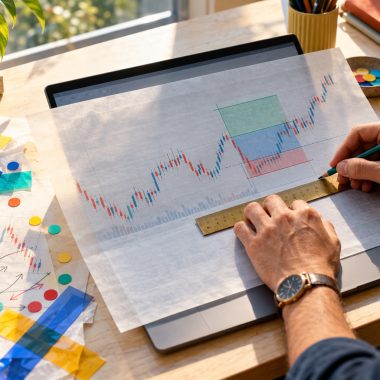

I have had trading days that looked productive from the outside and felt completely empty by the time I closed the platform. Several positions, plenty of chart time, a few good calls, a few bad ones, and enough activity to make me believe I had put in serious work. Then I would look back a few days later and realize I had mostly repeated the same habits at a higher speed.
That is the uncomfortable part of trading. Activity is easy to see, while progress is much quieter.
When I try to judge whether I am actually improving on Xcelerate Trade, I no longer start with the number of trades I took. I look at the quality of the decisions behind them, the amount of risk I accepted, the setups I refused, the way I behaved after a loss, and whether I followed the same process when the market became uncomfortable.
For me, genuine progress means becoming more consistent without becoming more reckless. It means needing fewer excuses after a trade is over. It also means being able to sit in front of a moving market and do absolutely nothing when the conditions I want are not there.
Trading More Is Not the Same as Getting Better
The confusion between activity and progress is understandable.
If I take three trades today instead of one, I have three times as many decisions to review. If I trade five sessions instead of two, I gain more exposure to changing market conditions. More repetition can help me learn faster.
But repetition alone does not create skill.
If I keep entering too early, adding unnecessary size, chasing moves after they begin, or changing my plan once money is at risk, trading more simply gives me more opportunities to rehearse weak behavior. I may become faster at making the same mistake.
I think of it the same way I think about learning a musical instrument. Playing a passage badly one hundred times does not automatically make the one hundred and first attempt better. Sometimes it simply makes the bad version familiar.
Trading works in much the same way.
A trader can accumulate thousands of positions without becoming especially disciplined. Another trader can take far fewer trades and develop a much clearer understanding of risk, timing, market conditions, and personal behavior.
That is why trade count, by itself, tells me very little.
I First Ask Whether My Decisions Are Becoming More Selective
One of the strongest signs of progress I have noticed is surprisingly simple. I can leave more trades alone.
Early on, doing nothing felt almost irresponsible.
I would watch a market for an hour and start feeling that the time needed to produce something. A position became proof that I had been paying attention.
That mindset caused more trouble than I realized.
When I felt I needed to take a trade, my standards became flexible. An average setup began looking decent. A decent setup began looking strong.
The market had not improved. My willingness to compromise had.
Now I judge a session partly by the trades I rejected.
If price reaches an area I was watching but the rest of the setup is missing, I want to be able to let it go. If volatility changes the character of the market, I want to notice that before I start forcing my normal approach onto abnormal conditions.
That restraint matters.
Xcelerate Trade Academy places considerable emphasis on structured decision making, risk control, psychology, and planned execution. I find that useful because it puts the focus where I think it belongs: on how a decision is made, not on how many decisions appear on the screen.
Sometimes progress looks like a busier journal.
Sometimes it looks like an almost empty one.
I Need to Understand What I Am Practicing
There is another problem with measuring progress only through frequency. It assumes that every trade is practice of the same quality.
That is rarely true.
Some trades come from a clear process. Others come from boredom, impatience, fear of missing out, frustration, or the simple desire to recover what I lost ten minutes earlier.
Before I can judge improvement, I need to be clear about the activity itself.
For anyone still establishing that foundation, What Is Trading is a useful starting point because a basic understanding of the activity makes later discussions about execution, risk, and progress much easier to place in context.
Once I understand the job, I can start evaluating whether I am becoming better at it.
That sounds obvious. In practice, I spent more time than I would like to admit studying entries before I had properly defined what a good decision actually looked like for me.
The charts were easier to study than my own behavior.
A Winning Trade Can Still Be a Bad Trade
This was one of the hardest lessons for me to accept.
A profitable trade is not automatically a good trade.
Suppose I see price moving quickly and enter because I am afraid of missing the move. My normal confirmation is absent, my position is larger than planned, and I cannot clearly explain where the trade becomes invalid.
Then price continues in my direction and I make money.
The account balance says I was right.
My process says something else.
If I treat that profit as proof that the decision was good, I teach myself a dangerous lesson. I begin associating rule breaking with success.
The market does reward poor decisions occasionally. That is part of what makes trading psychologically difficult.
A losing trade can create the opposite problem.
I can wait patiently, take a setup that fits the plan, define my risk properly, enter at the place I intended, and still lose. If I judge the entire trade only by the financial outcome, I may abandon a perfectly reasonable process because one result happened to be negative.
Over time, this distinction became important to me.
I want profitable trades, obviously. But when I review individual decisions, I first ask whether the trade was valid according to the process I had defined beforehand.
The financial result comes second.
Progress Often Appears in Risk Management Before It Appears in Profit
When people imagine a trader improving, they often picture better market calls.
I have found that improvement can appear somewhere much less glamorous.
Risk becomes predictable.
Before entering, I know where the trade no longer makes sense. I understand approximately how much of my capital I am willing to risk if the idea fails. My position size follows that decision.
The order matters.
When I start with the amount of money I hope to make, everything else becomes easier to distort. I can widen the stop because the position feels too small. I can increase size because the opportunity looks unusually attractive.
Before long, risk is being negotiated emotionally rather than calculated deliberately.
I prefer the opposite approach.
First comes the idea. Then comes invalidation.
Once I know where the trade is wrong, I can decide whether the distance to that point allows a sensible position size.
If the numbers do not fit my risk parameters, the trade can simply be skipped.
I see progress when this becomes normal rather than heroic.
There is no internal debate. No last-minute attempt to make the trade fit.
I either have an acceptable opportunity or I do not.
I Pay Close Attention to What I Do After a Loss
Before the first trade of the day, discipline can be surprisingly easy.
I am fresh. Nothing has gone wrong yet.
The revealing moment often comes after the first loss.
I have noticed that frustration does not always look dramatic. I do not need to slam the desk or double my position size to start revenge trading.
Sometimes it appears as urgency.
I begin scanning more aggressively. I find a new setup a little faster than usual.
A level that would normally need confirmation suddenly appears good enough.
That is why I ask myself a simple question after a loss: if the previous trade had never happened, would I still want this next one?
I do not always love the answer.
Progress, for me, means that the previous result has less influence on the next decision.
I can still feel annoyed. I can still dislike losing money.
The goal is not to become emotionally blank.
The real goal is to prevent temporary emotion from changing my standards.
Winning Streaks Can Distort My Judgment Too
Losses receive most of the attention in discussions about trading psychology, but winning can change behavior just as quickly.
After several good trades, confidence starts rising.
That is not necessarily bad.
The problem begins when confidence quietly becomes permission.
I take an entry that is slightly weaker because things have been going well. I stay in the market longer because I feel in tune with it.
Sometimes risk increases almost without discussion.
One extra position does not feel dangerous after a strong morning.
This is why I review winning days carefully.
I ask whether the quality of the later trades remained similar to the early ones. I look at whether position size stayed consistent.
A profitable session can contain poor decisions.
In fact, some of the most expensive habits in trading begin on days when the market rewards them.
Fewer Trades Can Be a Sign of Improvement
Imagine that I take seventy trades one month and forty the next.
The raw number tells me that my activity decreased.
It does not tell me whether my trading improved.
Maybe those thirty missing trades were weak setups that I finally learned to reject.
In that case, lower volume may be a strong sign of progress.
But perhaps I took fewer trades because a recent drawdown made me afraid to execute valid opportunities.
Now the same reduction has a completely different meaning.
Context matters.
I never want to judge trading frequency without asking why the frequency changed.
A lower number of trades can mean discipline.
It can also mean hesitation.
A higher number can mean improved opportunity recognition.
It can also mean overtrading.
The behavior behind the number tells the real story.
My Rules Need to Become Easier to Follow
I went through a period when I kept adding more conditions to my trading.
At the time, complexity felt like sophistication.
If the system had enough rules, enough filters, and enough chart language, I felt protected from uncertainty.
Markets do not work that way.
Eventually, too many rules made decisions harder rather than easier. Almost any trade could be justified after the fact because I had created enough concepts to explain whatever happened.
That was not useful.
I now prefer a process I can explain clearly and follow consistently.
If my setup requires ten minutes of explanation after the trade is closed, I become suspicious.
The trades I trust most are usually simpler.
I saw the condition I was waiting for. Price reached the area I had identified.
My invalidation was clear.
The risk made sense, so I executed.
Simple does not mean easy.
It means the decision can be reviewed without rewriting the story afterward.
My Trading Journal Needs to Record More Than Entries and Exits
A journal becomes useful when it tells me something about my behavior.
A chart screenshot alone cannot always do that.
I want to know how I felt before the trade. I want to know whether the setup was planned or discovered in the heat of the moment.
I want to record whether I followed my usual risk.
I also want to know what happened immediately before the trade.
Had I just won? Had I just lost?
Had I been watching the market for three hours and become impatient?
Those details can reveal patterns that price alone will never show me.
Over several weeks, I may discover that my first trades are generally more disciplined than my later ones.
I may find that a certain type of setup performs reasonably well, but I tend to overtrade it after a winning streak.
That knowledge gives me something concrete to work on.
Without a journal, memory becomes selective.
I remember the painful loss.
I remember the unusually good winner.
The ordinary trades disappear.
A written record makes those ordinary decisions visible, and ordinary decisions are where most of my habits live.
I Prefer Measuring Risk in Consistent Units
Money can make performance difficult to compare.
A $500 loss sounds worse than a $100 loss, but the numbers mean very little without knowing the size of the account and the planned risk.
That is why I find risk units useful.
If the amount I am prepared to lose on a trade represents one unit of risk, I can compare performance more consistently.
A trade that earns twice that amount can be viewed as roughly two units of reward relative to the initial risk.
This gives me a cleaner way to compare decisions across different account sizes and market conditions.
It also forces me to think about expectancy.
A trader does not need to win every trade.
No serious strategy should be judged that way.
What matters is the relationship between winning frequency, average winner, average loser, and the consistency of execution.
A strategy can lose frequently and still make sense if the winning trades are sufficiently larger.
Another strategy may win often but still struggle because occasional losses become too large.
Looking at the structure behind the outcomes tells me far more than celebrating a high win rate.
I Need More Than Five Trades Before I Believe a Story
Short sequences are emotionally persuasive.
Five wins can make me feel as if I have finally solved the market.
Five losses can convince me the entire approach has stopped working.
Both reactions can be premature.
Markets contain noise.
Even a well-designed approach can experience losing streaks, and a weak approach can enjoy a profitable run.
I have learned to be careful about making large changes from small samples.
There is no universal number of trades that suddenly turns uncertainty into certainty.
Different strategies operate at different frequencies.
Still, I want enough comparable observations before I start drawing conclusions.
The larger and cleaner the sample becomes, the easier it is to examine average loss, average gain, win rate, expectancy, execution quality, and the effect of different market conditions.
I try to apply the same patience when evaluating myself.
One disciplined afternoon does not prove that I have changed.
Several weeks of similar decisions mean more.
Backtesting Tells Me Whether I Understand the Setup or Only the Explanation
Live trading has an energy that historical testing cannot reproduce.
That energy is part of the problem.
It can make activity feel educational even when I am mostly reacting.
Historical testing and market replay remove some of that emotional noise.
They allow me to examine whether I can identify my setup repeatedly across different sessions.
The useful part comes when I cannot see what happens next.
Suddenly, hindsight disappears.
I have to make a decision from the information available at that moment.
That can be humbling.
A setup that looks obvious on a completed chart may be much harder to recognize in real time.
When I can identify the same structure consistently without knowing the outcome, I trust my understanding more.
When I only see the perfect trades after the move is finished, I probably understand the explanation better than I understand the execution.
Those are not the same skill.
Genuine Progress Reduces the Amount of Noise in My Head
When I was less experienced, nearly every candle seemed important.
I had an opinion about everything.
One move was bullish.
The next looked like a reversal.
Then I saw a breakout.
Thirty seconds later, I suspected the breakout might fail.
My attention was busy, but busy attention is not always useful attention.
With more structure, the internal conversation becomes quieter.
I know what I am waiting for.
Most price movement can happen without requiring a decision from me.
That has been one of the clearest signs of development.
I spend less energy interpreting every fluctuation and more energy waiting for the conditions relevant to my own process.
Trading becomes less dramatic.
I consider that a good thing.
Execution Should Become Less Emotional Over Time
The important thinking should happen before I enter.
I identify the setup.
I decide what would invalidate it.
I determine whether the risk is acceptable.
Then I execute.
If I open a position and immediately begin inventing new rules, the preparation was probably incomplete.
A mature trade feels different.
I still watch it.
I still care about the outcome.
But I am not renegotiating the entire idea every time price moves against me for a few seconds.
This is one of the reasons I like the emphasis Xcelerate.Trade places on preparation, risk, psychology, and execution as connected parts of the same process.
The chart is only one part of trading.
The decisions around it matter just as much.
Emotional Recovery Time Tells Me More Than I Expected
I cannot prevent every emotional reaction.
What I can observe is how long the reaction controls my behavior.
Years ago, one frustrating trade could affect the next hour.
Sometimes it affected the rest of the session.
Now I notice recovery time.
How quickly can I return to normal position sizing?
How quickly do my normal standards return?
Can I evaluate the next setup without trying to repair the previous result?
That recovery matters.
A trader who feels frustrated for five minutes and then follows the plan may be developing better control than someone who appears calm while repeatedly breaking rules.
Emotions are not the final problem.
Behavior is.
Better Traders Often Ask Better Questions
My questions have changed over time.
At first, I wanted to know how much I could make.
I wanted to know which setup would win most often.
Those questions are understandable, but they do not reveal much about process.
Now I am more interested in whether my stop represents genuine invalidation.
I want to know whether my position size reflects risk or excitement.
I ask whether I entered because my conditions appeared or because price was moving and I did not want to miss it.
Those questions feel less exciting.
They are much more useful.
I have also become more comfortable with uncertainty.
That may sound strange because improvement is often associated with confidence.
For me, genuine progress has made some forms of certainty disappear.
I understand more clearly what I do not control.
That makes me more careful, not less capable.
Profitability Still Matters
I do not want to turn process into an excuse for ignoring results.
Eventually, a trading method has to produce evidence that supports continuing to use it.
A disciplined strategy that loses money indefinitely is still a problem.
The key difference is that I do not judge the strategy from one afternoon.
I want a meaningful sample of properly executed trades.
Then I can examine whether the process appears to have positive expectancy.
If the evidence weakens over time, adjustment may be necessary.
The important point is that changes should come from evidence, not from discomfort.
I have changed good ideas too quickly simply because they went through a losing period.
I have also kept poor ideas too long because I liked them.
Neither approach was especially rational.
Progress means becoming a little less attached to both optimism and fear.
Sometimes the Best Session Is the One Where Almost Nothing Happens
I remember sessions where I finished with very little to write down.
No big winner.
No painful loss.
Maybe one position.
Maybe none.
Earlier in my development, I would have considered those days wasted.
Now I see them differently.
If the market never offers the conditions I am waiting for, staying out is part of the job.
I do not need the market to reward my presence.
That shift matters because overtrading often starts with the belief that screen time deserves payment.
It does not.
The market has no idea how long I have been sitting there.
It does not care how carefully I prepared.
Opportunity appears when it appears.
My responsibility is to recognize the difference between opportunity and impatience.
How I Know I Am Actually Progressing on Xcelerate Trade
I try to review my trading as if the account belonged to someone else.
That creates a little distance.
I look at whether weak setups are gradually disappearing.
I examine whether planned risk has become more stable and whether I interfere less after entering a trade.
I notice whether one loss still changes the next decision.
I look at how often I manufacture a trade because the session feels too quiet.
I also pay attention to whether I can repeat the same process on good days and bad ones.
Consistency under changing emotions means more to me than confidence when everything is going well.
If my trading volume rises while my standards, risk control, and execution remain stable, then trading more may represent real development.
If volume rises while the quality of my decisions deteriorates, I am simply becoming busier.
That distinction is the heart of the matter.
Progress Is Usually Quieter Than I Expected
Trading culture tends to make improvement look dramatic.
A larger account.
A spectacular winning day.
A perfect chart with an entry marked near the exact turning point.
My experience has been less cinematic.
Progress often appears in smaller moments.
I skip the trade that almost fits.
I keep the original stop instead of moving it.
I accept a loss without immediately trying to recover it.
I finish a strong morning without deciding that I have suddenly become unbeatable.
These moments rarely look impressive on a screenshot.
They matter anyway.
Over time, they change the character of the entire trading process.
The market does not become easier.
I simply stop making some parts of it harder than they need to be.
The Standard I Keep Coming Back To
The question I now ask myself is simple.
Am I becoming harder to push away from my own process?
If one losing trade can still change my standards, I have work to do.
If three winners tempt me to increase risk without a reason, I have work to do.
If boredom can persuade me that an average opportunity is suddenly excellent, there is still something to learn.
But if I recognize those impulses earlier, stay within planned risk, wait longer for better setups, and review performance without rewriting the past, then I know something is improving.
That is how I separate progress from activity on Xcelerate Trade.
The difference may eventually become visible in financial results.
Before that happens, I usually see it in behavior.
The unnecessary trade disappears.
The next loss feels less personal.
The profitable day no longer turns into an excuse to gamble through the afternoon.
And when I close Xcelerate.Trade at the end of a session, I care less about how many times I traded.
I care about whether I would make the same decisions again.
Frequently Asked Questions
How can I tell if I am improving as a trader on Xcelerate Trade?
I look for improvement in decision quality before I look at trade frequency. More consistent risk, greater patience, fewer impulsive entries, better adherence to a trading plan, and more stable behavior after wins or losses are stronger signs of development than simply taking more positions.
Financial performance still matters, but I prefer to judge it over a meaningful series of comparable trades. One unusually profitable day can say very little about whether my process is actually improving.
Does taking more trades help me become a better trader?
It can, but only when the additional trades are useful repetitions of a defined process. If I am taking more low-quality setups, entering because I am bored, or reacting emotionally after a loss, the extra activity can reinforce weak habits.
I would rather take fewer trades that I can review clearly than generate a large number of positions that follow different rules every time. Experience becomes valuable when I can learn something repeatable from it.
Is trading less sometimes a sign of progress?
Yes. I often see lower trading frequency as a positive sign when it comes from better selectivity.
If I used to take ten average setups and now recognize that only three of them actually meet my conditions, taking three trades may represent substantial improvement. The important question is why the number changed.
Trading less because of fear is different from trading less because standards have improved. I try not to confuse the two.
What should I track besides profit and loss?
I pay attention to planned risk, actual risk, rule adherence, entry quality, exit behavior, emotional state, market conditions, and the reason I took the trade. I also want to know whether the trade was planned in advance or justified after I became emotionally interested in the move.
Over time, those observations help me identify recurring behavior. That is often more useful than knowing only how much money a particular trade made or lost.
How many trades do I need before I can judge my progress?
There is no single number that works for every strategy or trader. A high-frequency method naturally produces a meaningful sample faster than a setup that appears only a few times each month.
I try to avoid major conclusions from a handful of trades. The more comparable, properly documented decisions I can review, the more useful the analysis becomes.
What matters is not collecting trades as quickly as possible. It is building a sample that reflects the same process under enough different conditions to reveal a pattern.
Can I be improving even if I am still losing some trades?
Absolutely. Losing trades are part of trading because no method removes uncertainty.
I can take a well-planned position, manage risk correctly, follow my rules, and still lose. That does not automatically mean the decision was poor.
I become more concerned when losses come from repeated rule violations or when emotional reactions begin changing my behavior. A controlled loss within a defined process is very different from an uncontrolled one.
What is the clearest sign of overtrading?
For me, it is the gradual weakening of my entry standards.
I start accepting setups I would normally reject. I find reasons to enter rather than reasons to wait.
Another warning sign is urgency after a losing trade. If I feel that I need another position quickly because I want to recover money, I am no longer evaluating the next opportunity independently.
How important is a trading journal for measuring progress?
I find it extremely useful because memory is unreliable.
Without a journal, I tend to remember unusually good wins and especially painful losses. The ordinary trades, which often reveal my real habits, fade quickly.
A useful journal records more than entry and exit prices. It helps me see whether my behavior, risk, timing, and decision quality are changing across many sessions.
Should I focus on win rate when evaluating my performance?
Win rate is useful, but I never look at it alone.
A high win rate can still produce poor results if losses are much larger than winners. A lower win rate can work when the average profitable trade is significantly larger than the average loss.
I prefer to look at the relationship between win rate, average gain, average loss, risk per trade, and execution consistency. Together, those numbers give me a more realistic picture.
How do I know whether a strategy needs changing or I simply need more discipline?
I first separate strategy performance from execution quality.
If I am constantly breaking the rules, I do not yet have clean evidence that the strategy itself is the problem. I may simply be testing my own inconsistency.
When I can execute the approach consistently across a reasonable sample and the results still fail to support the original assumptions, then I have a stronger reason to review the strategy itself. That distinction has saved me from changing plans every time I encounter a difficult week.
Is profitability the final measure of trading progress?
Over the long term, profitability matters because trading is a financial activity.
But profitability by itself does not explain how the result was produced.
A trader can make money temporarily through excessive risk. Another trader can go through a difficult period while executing a sound process.
I therefore treat profitability as one part of the evidence. I want sustainable results supported by repeatable decisions, controlled risk, and behavior I can maintain when market conditions change.
What should progress feel like in day-to-day trading?
For me, it feels quieter.
I spend less time trying to predict every movement. I feel less pressure to participate constantly.
Losses still bother me, and good trades still feel good, but neither one changes my behavior as dramatically as before.
That quieter relationship with the market may not look impressive from outside. It is one of the clearest signs I know that trading is becoming more deliberate and less reactive.